
Peptides
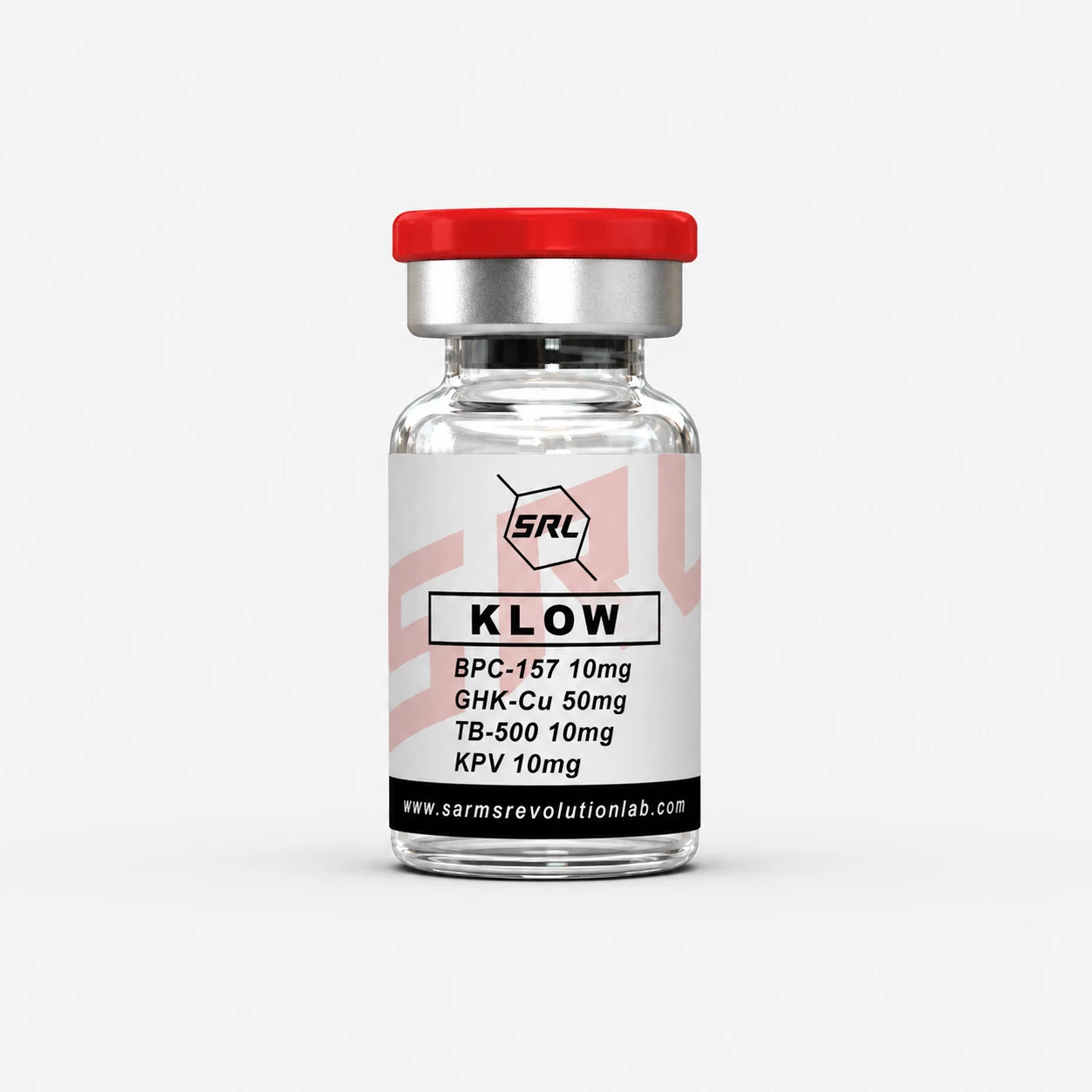
KLOW
Size: 80 mg
KLOW 80 mg combines GHK-Cu, BPC-157, TB-500 and KPV for laboratory studies of tissue-remodelling and inflammatory pathways; ingredient research does not establish outcomes for the complete blend. For laboratory and in-vitro research only—not for human or veterinary use.
$184.99
Buy 5 -> get 1 FREE
Buy 10 -> get 3 FREE
Buy 20 -> get 7 FREE
| Rule | Range | Discount |
|---|---|---|
| Individual Products Quantity Discount | 3 - 5 | 20% $147.99 |
| Individual Products Quantity Discount | 6 - 8 | 25% $138.74 |
| Individual Products Quantity Discount | 9 - 11 | 30% $129.49 |
| Individual Products Quantity Discount | 12 - 23 | 35% $120.24 |
| Individual Products Quantity Discount | 24 + | 45% $101.74 |
Pay by E-Transfer

fast
Delivery

Secure
ordering

High
potency

Satisfaction
guarantee
Description
KLOW 80 mg research blend information
| Product | KLOW |
|---|---|
| Total listed content | 80 mg |
| Named components | GHK-Cu, BPC-157, TB-500 and KPV |
| Seller | SARMs Revolution Lab, Canada |
| Intended use | laboratory research only |
Confirm the component-by-component allocation, sequence identity and batch documentation on the vial and accompanying certificate. A total milligram value alone does not establish the amount of each component.
What is the KLOW peptide blend?
KLOW combines four materials associated with different research literatures. GHK-Cu is a copper-binding tripeptide studied in tissue-remodelling models. BPC-157 is an experimental pentadecapeptide with predominantly preclinical evidence. TB-500 is a commercial name associated with thymosin beta-4-fragment research. KPV is the C-terminal tripeptide Lys-Pro-Val derived from alpha-MSH research.
These descriptions identify separate fields of study. They do not prove synergy, compatibility, clinical benefit or human safety when all four are combined.
What is known about KPV and the other components?
Cell research has examined KPV in NF-kB and chemokine signalling. GHK-Cu reviews discuss matrix remodelling; thymosin beta-4 literature covers actin binding and cell migration; and BPC-157 literature remains heavily animal-based. No controlled human study was identified for the complete KLOW formulation.
Researchers should distinguish evidence about a purified individual compound from evidence about a multi-component blend. Analytical interference, stability and component ratios become additional variables.
KLOW evidence and regulatory limits
KLOW should not be presented as proven to heal injuries, control inflammation, accelerate recovery or improve performance. Health Canada has warned about unauthorized injectable peptides sold online. This page does not provide dosage, reconstitution, injection, stacking or treatment instructions.
KLOW 80 mg frequently asked questions
Which components are named in KLOW?
The product listing names GHK-Cu, BPC-157, TB-500 and KPV.
How much material is in the vial?
The listing identifies 80 mg total. Verify the amount of each component on the label and batch documentation.
Has the full four-component KLOW blend been clinically studied?
No controlled human evidence for this exact commercial formulation was identified. Separate component studies do not prove the blend.
Does KPV research prove an anti-inflammatory treatment?
No. Cell and animal pathway findings support research questions but do not establish a therapeutic outcome for this vial.
Does this page provide a KLOW protocol?
No. It provides identification and scientific context only.
Where can the individual components be reviewed?
See SRL pages for GHK-Cu, BPC-157 and TB-500, plus the peptide category.
Scientific references
- Cell research on KPV and NF-kB signalling. 2012.
- Review of GHK and tissue remodelling. 2008.
- Review of thymosin beta-4 structure and biological properties. 2010.
- Systematic review of BPC-157 research. 2025.
Research-use notice: KLOW 80 mg is offered strictly for laboratory research and analytical work. It is not intended for human consumption, self-administration, diagnosis, treatment or veterinary use.
Be the first to review “KLOW” Cancel reply
You must be logged in to post a review.
ABOUT OUR
EXTERNAL
TESTING PROCEDURE
Relying on third-party laboratory testing ensures an impartial and unbiased information source, offering consumers the utmost transparency. Independent testing prevents companies from manipulating internal results or disseminating inaccurate information.
Objectives of External Testing
- Ensuring Transparency for Consumers
- Providing Unbiased and Independent Reports
- Ensuring Safety Standards
Reviews
There are no reviews yet.